- Seokhyeon Park, Seoul National University
- Soohyun Lee, Seoul National University
- Eugene Choi, Seoul National University
- Hyunwoo Kim, Seoul National University
- Minkyu Kweon, Seoul National University
- Yumin Song, Seoul National University
- Jinwook Seo, Seoul National University
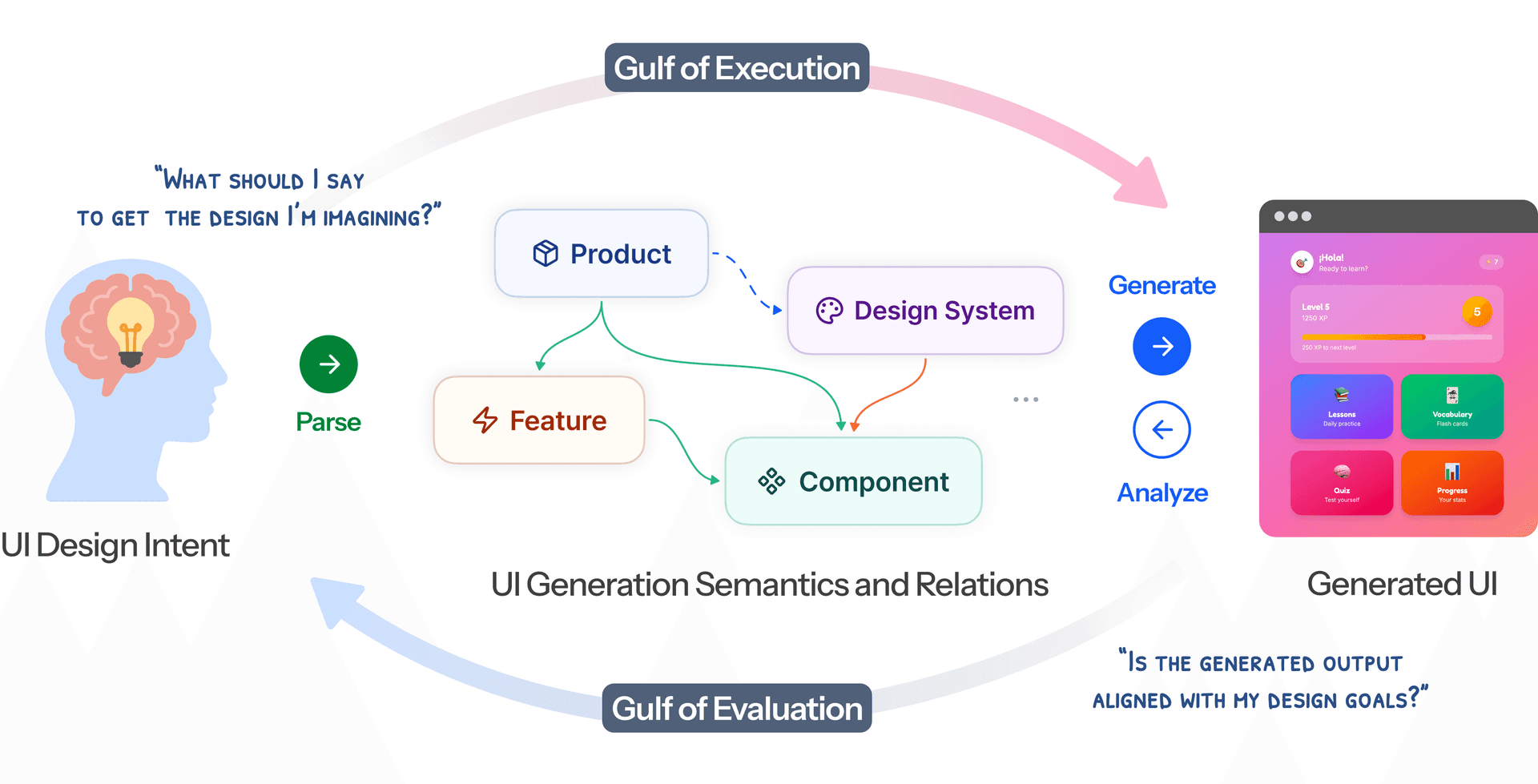
While generative AI enables high-fidelity UI generation from text prompts, users struggle to articulate design intent and evaluate or refine results—creating gulfs of execution and evaluation. To understand the information needed for UI generation, we conducted a thematic analysis of UI prompting guidelines, identifying key design semantics and discovering that they are hierarchical and interdependent. Leveraging these findings, we developed a system that enables users to specify semantics, visualize relationships, and extract how semantics are reflected in generated UIs. By making semantics serve as an intermediate representation between human intent and AI output, our system bridges both gulfs by making requirements explicit and outcomes interpretable. A comparative user study suggests that our approach enhances users' perceived control over intent expression, outcome interpretation, and facilitates more predictable, iterative refinement. Our work demonstrates how explicit semantic representation enables systematic and explainable exploration of design possibilities in AI-driven UI design.