- Jeongmin Rhee, Seoul National University
- Changhee Lee, Pohang University of Science and Technology
- Hyunwoo Kim, Seoul National University
- Kiroong Choe, Seoul National University
- Bohyoung Kim, Hankuk University of Foreign Studies
- Sungahn Ko, Pohang University of Science and Technology
- Jinwook Seo, Seoul National University
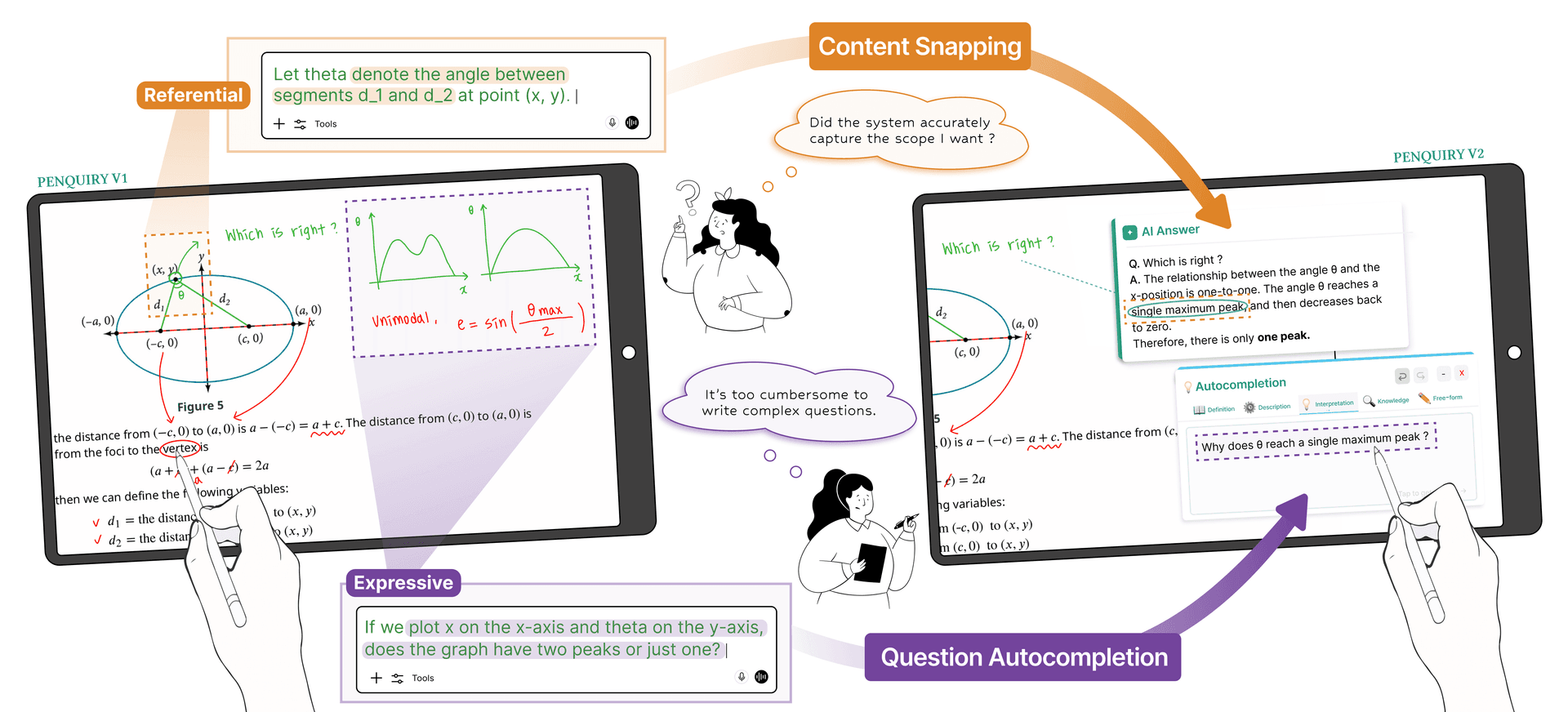
Pen-based digital devices remain a preferred medium for active, cognitively engaging study. Concurrently, Large Language Models (LLMs) have become indispensable for self-directed learning, enabling students to clarify concepts. However, a fundamental interaction gap exists between the fluid, spatial nature of pen-based workflows and the discrete, keyboard-heavy requirements of LLMs. We present Penquiry, an in-situ question-and-answer system that bridges this gap by enabling learners to pose questions directly on digital study materials via a pen. We characterize two primary interaction challenges in this multimodal transition: a Referential Barrier, which hinders grounding fine-grained visual elements into the query context, and an Expressive Barrier, which forces learners to translate diverse, non-textual intents-such as equations and diagrams-into rigid, typed sentences. To resolve these, Penquiry introduces a mediation layer featuring Content Snapping for unambiguous referencing and Question Autocompletion to expand sparse ink keywords into rich semantic queries. Through two iterative user studies (N=16 per study), we demonstrate that Penquiry significantly reduces the cognitive and physical overhead of inquiry compared to traditional interfaces, providing a new blueprint for pen-based, in-situ AI interaction.