- Soohyun Lee, Seoul National University
- Seokhyeon Park, Seoul National University
- Minsuk Chang, Georgia Institute of Technology
- Jinwook Seo, Seoul National University
Established rankings of visual channels such as position, length, area, and color have largely been based on the accuracy of magnitude estimation in complete charts. However, channel effectiveness also depends on other perceptual tasks, and chart elements such as axes, gridlines, and adjacent marks can affect how channels are perceived.
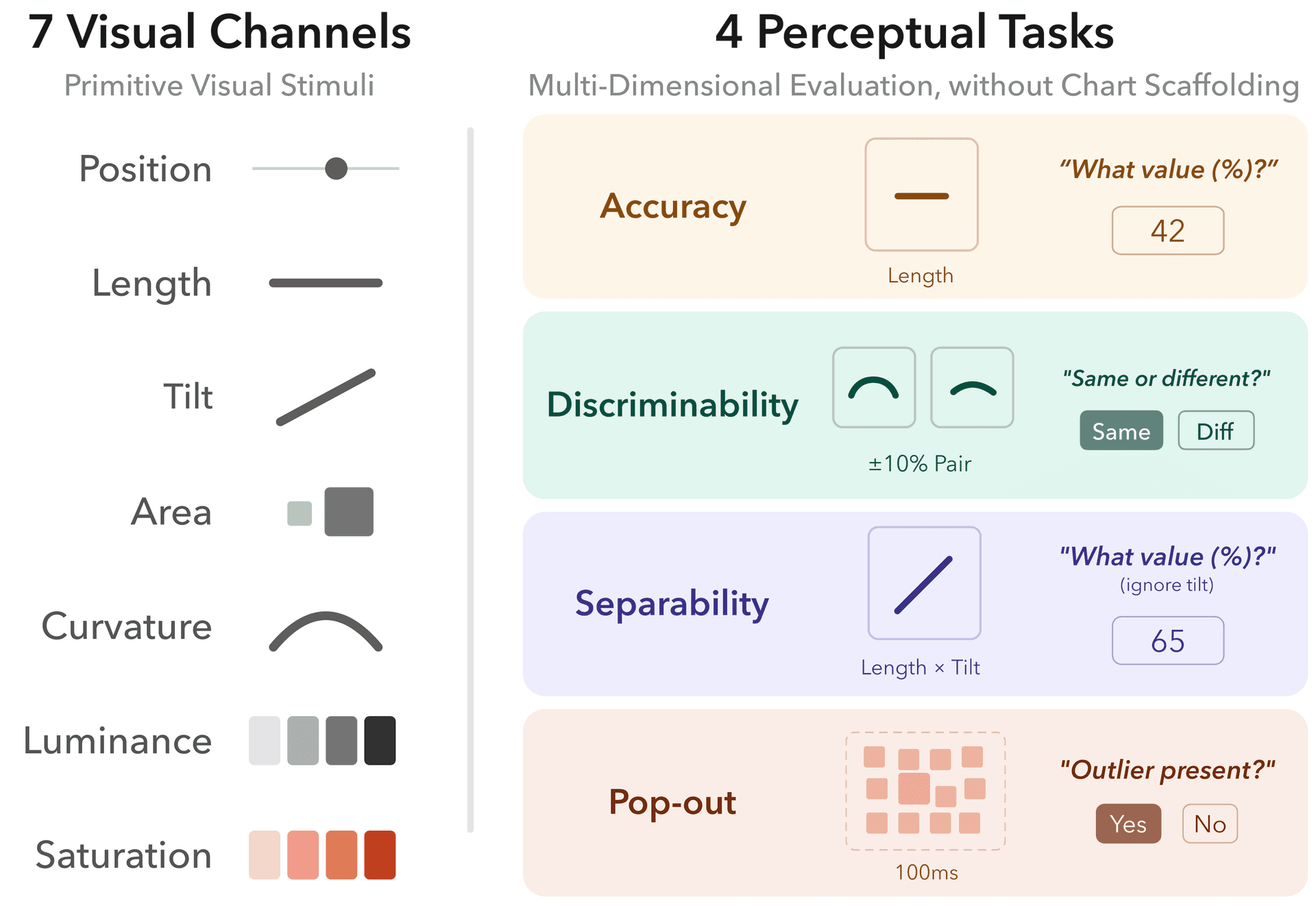
We evaluate seven visual channels—position, length, tilt, area, curvature, luminance, and saturation—using primitive visual stimuli stripped of chart-specific scaffolding. We assess the channels across four perceptual tasks: accuracy, discriminability, separability, and pop-out.
The results show that channel effectiveness cannot be described by a single ranking. Accuracy depends strongly on the availability of stable reference frames, while discriminability varies across both channels and value ranges. Pairwise channel interference is often asymmetric. We also observe a clear difference between magnitude estimation and pop-out detection: length performs well for accurate estimation but only moderately for detection, whereas area shows the opposite pattern.
In earlier work, we examined the graphical perception of image embedding models using six of these magnitude channels. We used embedding linearity to assess magnitude representation and distances between adjacent embeddings to examine discriminability. The resulting patterns differ substantially from human perception, indicating that general-purpose image encoders do not necessarily represent visual channels in a human-aligned manner.
Rather than proposing another universal ranking, this work characterizes channel effectiveness across multiple perceptual dimensions and provides a scenario-driven basis for selecting visual channels.